
Most sellers think TikTok Shop is only about going viral, so they never learn how to do TikTok Shop SEO. That is a mistake. TikTok Shop has a working search bar, a shoppable Shop tab, and an algorithm that decides which products show up for which searches. In 2026, the shops that show up in search are winning quiet, repeatable sales while everyone else chases one-off viral moments. Here is how the ranking actually works and what to do about it.
TikTok Shop SEO ranks listings on keyword relevance plus behavioral signals. Use buyer keywords in your title, description, and videos, then keep watch time, conversions, and fresh reviews strong.
Key takeaways
- Rank on both keywords and behavior; engagement decides how high you place.
- Write buyer keywords shoppers actually type, pulled from reviews and comments.
- Repeat your keyword in the caption, voiceover, and on-screen text.
- Review velocity outweighs total count; fresh reviews beat old ones.
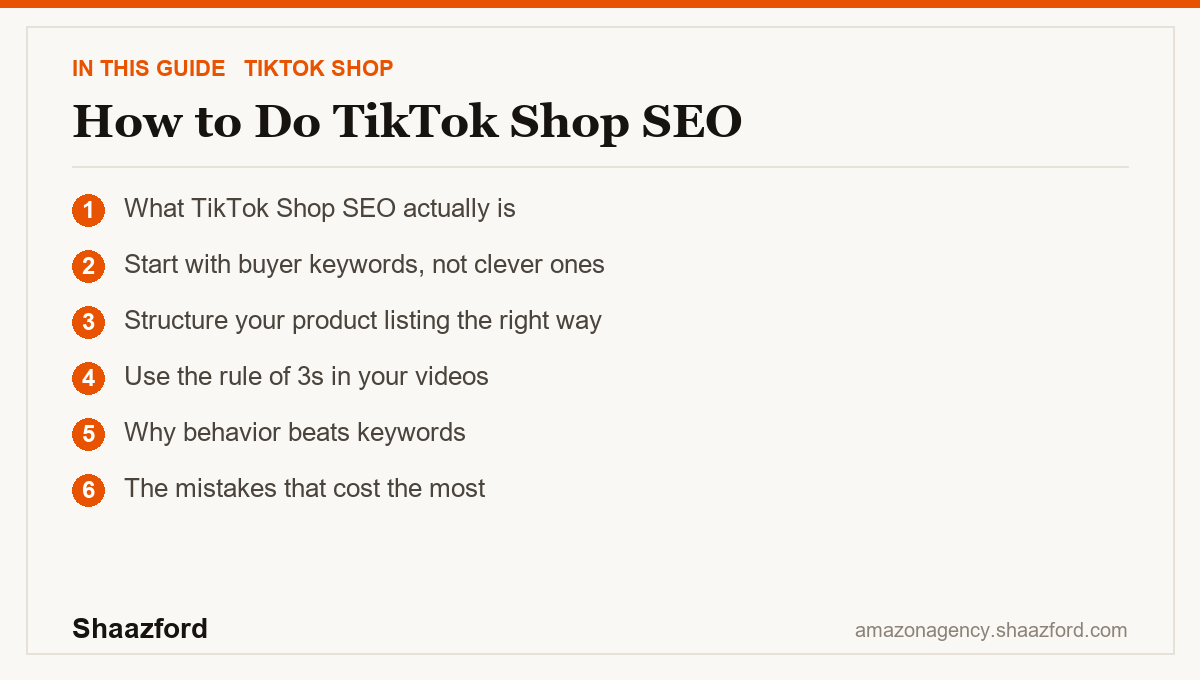
What TikTok Shop SEO actually is
TikTok Shop SEO is the practice of getting your products to surface when shoppers search, browse the Shop tab, and scroll shoppable video. TikTok ranks listings using a blend of keyword relevance and behavioral signals. Keywords tell the algorithm what your product is. Behavior, watch time, add-to-carts, conversion rate, and recent reviews, tells it whether your product is worth showing. You need both. Perfect keywords on a listing nobody engages with will not rank, and a great product with the wrong words will never get found in the first place.
Start with buyer keywords, not clever ones
The most common beginner error is writing keywords the way a marketer talks, not the way a shopper searches. TikTok search is conversational and problem-led. An Amazon shopper types "wireless bluetooth earbuds." A TikTok shopper types "earbuds that do not fall out during a workout." Build your keyword list from the problem your product solves and the exact language customers use to describe it. Read your reviews and competitor comments, that is where the real search phrases live. Update the list weekly, because on TikTok the language shifts as trends move.
Structure your product listing the right way
Once you have your keywords, put them where the algorithm looks:
- - Title. Put your main keyword first. Follow it with a couple of modifier keywords that add category, use case, or a key attribute. Front-loading signals relevance.
- - Description. Lead the first line with the primary keyword and the core benefit. Then cover use cases, materials, instructions, and attributes in plain, compliance-safe language. Do not stuff, write for a human who is deciding whether to buy.
- - Category and attributes. Confirm your category, variations, price, and shipping promise are all set correctly. Wrong or missing attributes quietly suppress your visibility.
Use the rule of 3s in your videos
On TikTok, your content is part of your SEO. For each product video, reinforce your target keyword in three places: once in the caption, once in the voiceover or audio, and once in the on-screen text. Add a few relevant, specific hashtags rather than broad ones. This gives TikTok consistent signals about what your video and product are for, and it connects your organic content to your listing so both rank for the same searches.
Why behavior beats keywords
Here is the part most guides underplay. In 2026, TikTok Shop SEO is mostly about behavior, not words. The algorithm ranks what converts. A listing with strong watch time, a healthy add-to-cart rate, and steady sales will outrank a keyword-perfect listing that nobody engages with. Your job is not to trick the algorithm with keywords, it is to give it evidence that shoppers want your product.
The clearest example is review velocity. Total review count matters less than how fresh your reviews are. A product with 20 new reviews in the last 7 days will often outrank a product with 1,000 old reviews and no recent activity. That means SEO is not a one-time listing task. It is an ongoing loop of new content, new sales, and new reviews that keeps feeding the algorithm proof of demand.
The mistakes that cost the most
The first mistake is treating SEO as a set-and-forget listing job. You write the title once, then wonder why rankings fade. TikTok rewards recency, so momentum has to be maintained. The second is using creative keywords instead of buyer keywords, optimizing for words no shopper actually types. The third is ignoring the behavioral side entirely, pouring effort into keywords while watch time, conversion, and review velocity, the signals that actually move ranking, go untended. Keywords get you eligible to rank. Behavior gets you ranked.
Where TikTok Shop SEO is heading in 2026
Search is becoming a bigger share of how buyers discover products on TikTok, not a smaller one, and the platform is layering A I into discovery, including A I-assisted search results and content selection. The practical takeaway is that the gap between "content brand" and "search brand" is closing. The sellers who win in 2026 map search demand, build listings around the exact language shoppers use, brief their creators with that same vocabulary, and keep fresh reviews and content flowing. SEO and content stop being separate jobs and become one system.
Want TikTok Shop SEO run as a system?
Ranking on TikTok Shop is not one task, it is a loop of research, listings, content, and reviews working together. Shaazford runs TikTok Shop SEO and growth for established brands under one strategy, with senior Amazon agency directors and flat pricing, never a percentage of your ad spend. If you want your products found and converting, talk to Shaazford.