
TikTok Shop is one of the fastest-growing places to sell online, and figuring out how to sell on TikTok Shop is more approachable than most beginners think. It is free to start, you do not need a big following, and the biggest fee myth online is simply wrong. Here is the real step-by-step, the true costs, and the strategy that separates shops that sell from shops that sit quiet.
To sell on TikTok Shop, register at seller.tiktok.com, verify your ID, add tax info, list products, choose fulfillment, then enable the Affiliate Program so creators sell for you. No followers are required.
Key takeaways
- You need zero followers to open a TikTok Shop.
- The referral fee is 6% of item price, 5% for certain jewelry.
- New sellers can unlock a 3% referral fee for their first 30 days.
- Reaching $2,000 in sales with no tax form can pause selling.
Do you need followers to sell on TikTok Shop?
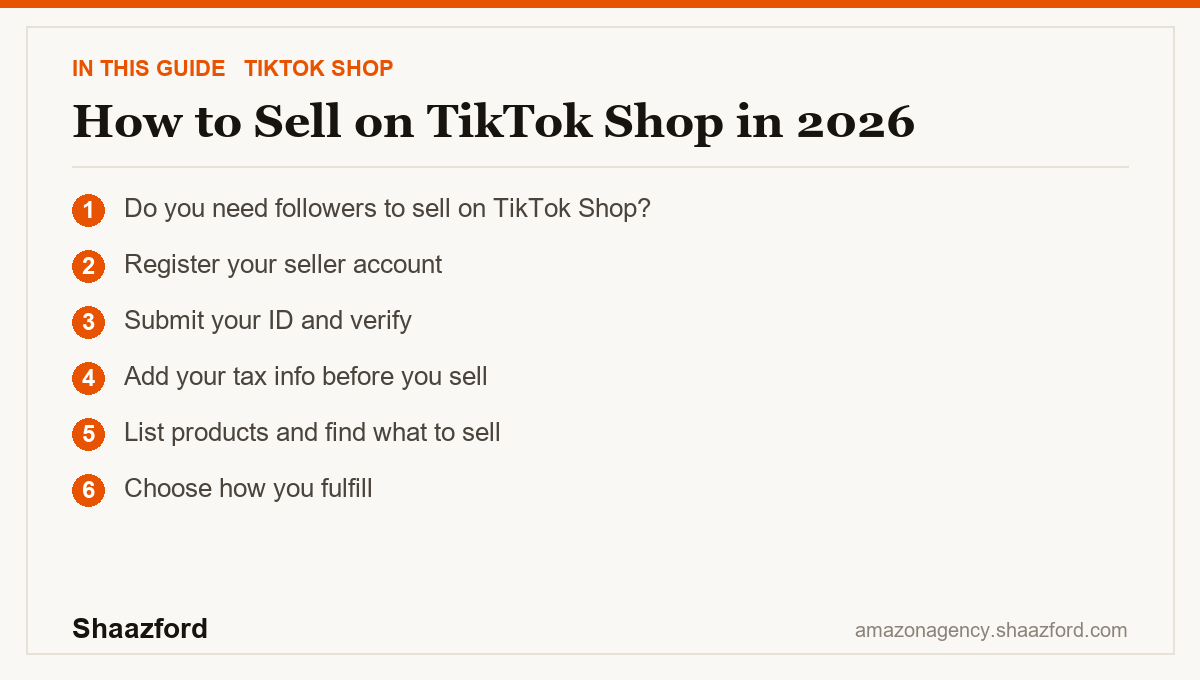
No. This is the first myth to clear. You do not need any followers to open a TikTok Shop. A brand-new account with zero followers can register and sell. (Follower thresholds apply to becoming a creator-affiliate, not to opening a shop.) To sell, you need to be US-based, 18 or older, with a US government ID, a US address, and a US bank account.
Step 1: Register your seller account
Go to seller.tiktok.com, sign up, and link an existing TikTok account or create a new one. Choose your seller type: Individual, Sole Proprietorship, or Corporation/Partnership. Individual sellers can register with a personal ID and bank account, you do not need a registered business to begin.
Step 2: Submit your ID and verify
Upload your identity document and a proof of address (a utility bill, bank statement, or similar) that matches the details you entered. Then you wait for verification. Most US sellers are approved in about 1 to 3 business days, though it can occasionally take up to a week. Tip: the name across your ID, your registration, and your bank account must match exactly, or your application and payouts will stall.
Step 3: Add your tax info before you sell
Do not skip this. Add your tax information, your W-9, before you start selling. Two rules bite beginners here: if you never add tax info, TikTok is required to withhold 24% of your payouts, and if you reach $2,000 in sales with no tax form on file, TikTok can pause your ability to sell and hold your money. Handle it on day one.
Step 4: List products and find what to sell
Now upload your products with titles, descriptions, images or video, price, and categories. If you are wondering how to find products to sell on TikTok Shop, look for items that demo well on video, solve a visible problem, and have enough margin to fund creator commissions (more on that next). Products that are boring to watch rarely move here.
Step 5: Choose how you fulfill
You can ship orders yourself, connect a catalog integration like Shopify or a print-on-demand app, or enroll in Fulfilled by TikTok so TikTok stores and ships for you. Start with whatever keeps your shipping fast and reliable, late dispatch hurts your visibility.
Step 6: Turn on the growth engine
This is where TikTok Shop is different. Enable the Affiliate Program, set a commission, and let creators sell for you. Post shoppable videos, and when you are ready, run LIVE shopping sessions with a real run-of-show. The affiliate/creator engine, not static listings, is what drives volume on this platform.
What it costs to sell on TikTok Shop in 2026
It is free to sell on TikTok Shop to start, you only pay when you sell. The referral (commission) fee is 6% of the item price for most categories (5% for certain jewelry). You may have seen an "8%" figure floating around: that was announced back in 2024 and never took effect, so ignore it. New sellers who make a first sale within 60 days of onboarding can unlock a 3% referral fee for their first 30 days. Just remember the headline 6% is not your whole cost, creator commissions (often 10% to 20%), fulfillment, ads, and returns stack on top, so price with the full picture in mind.
The beginner mistakes that cost the most
The first mistake is treating TikTok Shop like Amazon, polished photos, bullet points, and waiting. TikTok is video-first and creator-first; catalog-style listings without native content rarely get seen. The second mistake is underpaying affiliates. If the category benchmark is around 15% to 20% and you offer 8%, creators promote someone else. Set a competitive commission and recruit micro and nano creators (roughly 5,000 to 50,000 followers), who often convert better than big names. The third mistake is unstructured LIVE selling, treat a LIVE like a show with an opener, proof points, and a time-boxed offer, not a hangout.
Where TikTok Shop is heading in 2026
TikTok has been shipping AI tools for sellers, including a CRM to re-engage past buyers and abandoned carts, and creative tools that auto-select your best-performing content. Its Symphony suite can even generate AI avatar videos for product demos. For a beginner, the signal is clear: content volume and creator partnerships matter more than a perfect product page.
Want TikTok Shop to actually scale?
Getting approved is the easy part. Building a creator-affiliate engine, running profitable LIVEs, and keeping account health strong is a full operation. Shaazford runs TikTok Shop growth for established brands under one strategy, with senior Amazon agency directors and flat pricing. If you are ready to grow, talk to Shaazford.