
If you want to know how to do product research on Amazon, treat it as a workflow, not a lucky scroll through Best Sellers. Good research moves in order: gather ideas, measure demand, size up competition, find a gap, then confirm the margin. Do it in that sequence and you end an hour with a real shortlist instead of a hunch. Here is the beginner process for 2026, built mostly on data Amazon gives you for free.
Treat Amazon product research as a five-step workflow: gather ideas, measure demand, size up competition, find a gap in the reviews, then confirm margin in the Revenue Calculator before you commit.
Key takeaways
- Gather ideas from Amazon Best Sellers and Movers and Shakers.
- Product Opportunity Explorer is included with the $39.99 Professional plan.
- Read one and two-star reviews to find a real product edge.
- Confirm margin in the Revenue Calculator before ordering inventory.
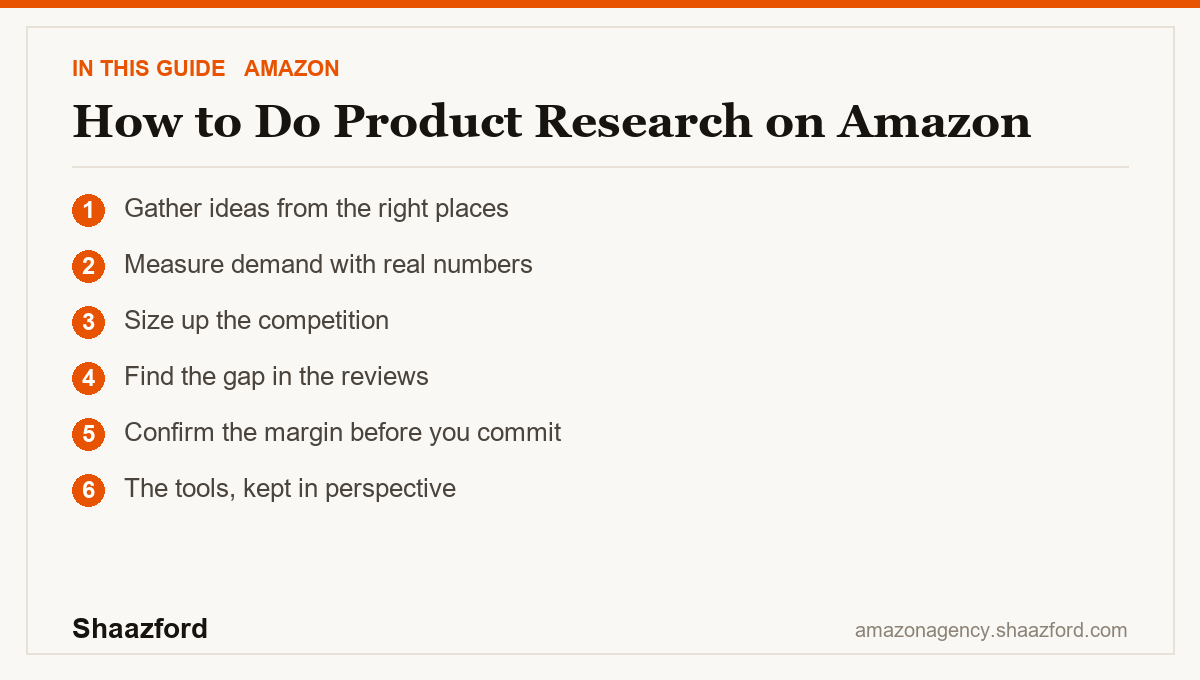
Step 1: Gather ideas from the right places
Start wide. Browse Amazon's Best Sellers to see what moves consistently, and Movers and Shakers to spot categories gaining momentum. Look at what everyday people buy repeatedly, not one-day spikes tied to a headline. Keep a simple list of categories and product ideas that show steady interest. The goal here is quantity of candidates, you will filter hard in the next steps.
Step 2: Measure demand with real numbers
Now replace opinion with data. Amazon's Product Opportunity Explorer analyzes searches, purchases, reviews, and pricing to show demand and gaps, and in 2026 it added two-year historical data so you can see seasonality and time your entry. It is available to Professional-plan sellers. Third-party tools like Jungle Scout and Helium 10 add search volume and estimated monthly sales. Whichever you use, you are answering one question: do enough people actually buy this, consistently, to make it worth selling.
Step 3: Size up the competition
Demand alone is not opportunity. For each candidate, search the main keyword and read two signals. First, how many results come back, thousands of near-identical listings signals saturation. Second, how many reviews the top listings carry, leaders with hundreds or thousands of reviews are hard to displace as a beginner. You want a niche with manageable results and top sellers you could realistically catch, rather than a mature category defended by years of social proof.
Step 4: Find the gap in the reviews
This is the step most beginners skip, and it is where the real finding lives. Open the top three or four listings and read their 1 and 2-star reviews. Patterns emerge fast: a part that breaks, sizing that runs small, a missing accessory, instructions no one understands. Those repeated complaints are a map of what buyers wish existed. A product that fixes a genuine, recurring problem has a reason to be chosen. Copying the market leader does not.
Step 5: Confirm the margin before you commit
Finish with the math. Take your shortlist into Amazon's Revenue Calculator and enter cost, price, and dimensions. It returns the referral fee (typically 15%), the FBA fulfillment fee, and your estimated margin on that exact item. Aim to keep meaningful profit after all fees. A product that passes demand, competition, and the review test but dies on margin is not a finding, it is a lesson learned cheaply before you spent on inventory.
The tools, kept in perspective
Product Opportunity Explorer is the strongest free option and worth the Professional plan on its own for serious research. Paid suites speed up demand and keyword checks and add competitor tracking. But no tool replaces reading reviews with your own eyes, because the gap you find there is judgment, not a metric a dashboard hands you. Use tools to move faster through steps 2 and 3, then do steps 4 and 5 yourself.
The beginner mistakes that cost the most
First, stopping at demand. Picking the product with the biggest search number ignores that heavy demand usually comes with heavy competition. High demand plus a crowded field is a fight, not an opening.
Second, researching with no system. Random scrolling produces random results. Running the same five steps on every candidate makes your shortlist trustworthy.
Third, skipping the reviews. The complaints on top listings are the single richest source of a real edge, and most beginners never read them.
Fourth, validating margin last or never. A product can clear every other test and still lose money after fees. Confirm the numbers before you fall in love with the idea.
Where product research is heading in 2026
Research is getting more data-rich and more review-driven at the same time. Product Opportunity Explorer keeps adding AI-driven demand insights and historical depth, so beginners have access to signals that used to require paid tools. And because Amazon's AI shopping assistant now reads listings and reviews to answer buyer questions and shape recommendations, the review patterns you mine in step 4 are the same signals shoppers see. Researching for a product buyers genuinely keep and praise is no longer optional polish, it is central to whether the product sells at all.
Want a research partner?
Doing the workflow once is straightforward. Running it reliably, on every product, before every order, is where results come from. Shaazford runs Amazon research and growth strategy for brands, with senior Amazon agency directors and flat pricing, never a percentage of your ad spend. Follow along for more, and when you want experienced eyes on your shortlist, talk to Shaazford.