
If you are learning how to sell on Amazon FBA, the mechanics are approachable and the math is where new sellers get caught. FBA (Fulfilled by Amazon) means Amazon stores your inventory, then picks, packs, and ships each order and handles most customer service. You send the boxes, Amazon does the logistics. This is the step-by-step version for a new seller, with the current 2026 fees written plainly so you price with real numbers.
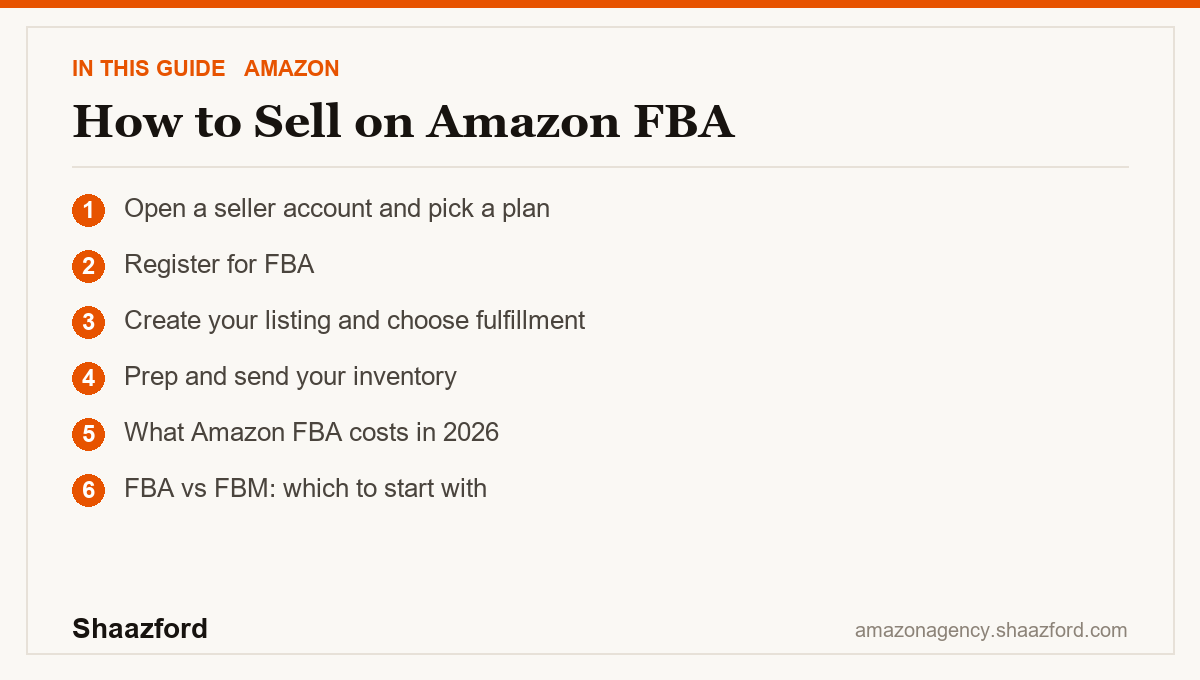
To sell on Amazon FBA, open a seller account, register for FBA in Seller Central, create a listing set to Amazon fulfillment, then prep and ship your inventory to Amazon's fulfillment centers.
Key takeaways
- FBA costs stack referral, per-unit fulfillment, storage, and aged inventory fees.
- Fulfillment fees rose about 8 cents per unit on January 15, 2026.
- A 3.5% fuel and logistics surcharge took effect April 17, 2026.
- Run every product through Amazon's Revenue Calculator before ordering inventory.
Step 1: Open a seller account and pick a plan
Sign up at sell.amazon.com. You will need a bank account for payouts (they land roughly every 14 days), a chargeable credit card, a government-issued photo ID, your tax information (an SSN for individuals or an EIN for a business), and a phone number. Most new accounts complete an identity verification step, so have your ID ready.
Choose a selling plan. The Individual plan is 99 cents per item with no monthly fee. The Professional plan is $39.99 a month with no per-item fee and becomes the better deal past about 40 units. For FBA specifically, most sellers go Professional, because the plan unlocks the tools and programs you will use to grow.
Step 2: Register for FBA
Inside Seller Central, open the settings gear, go to Account Info, then Manage, and select Register for FBA. This enrolls your account so you can assign products to Amazon's fulfillment network.
Step 3: Create your listing and choose fulfillment
Create the product listing, then set it to be fulfilled by Amazon. Before you commit, check restrictions. Some categories are gated, and FBA has its own prep and packaging rules on top of Amazon's general product restrictions. Reading them once saves you a rejected shipment later.
Step 4: Prep and send your inventory
Prep your units to Amazon's guidelines, which may include labeling, poly-bagging, or bundling. Build a shipping plan in Seller Central, and Amazon will tell you which fulfillment centers to send to. Print the Amazon shipping labels, apply them, and ship. Once your inventory checks in, it becomes available to Prime customers and Amazon takes over fulfillment.
What Amazon FBA costs in 2026
This is the part beginners underestimate. Your costs stack in layers:
- - Referral fee on each sale, typically 8% to 15%, with most categories at 15% and a $0.30 minimum.
- - FBA fulfillment fee per unit, based on size and weight. After a 2025 freeze, Amazon raised these on January 15, 2026, by about 8 cents per unit on average, with small standard items up around 12 cents.
- - A new 3.5% fuel and logistics surcharge applied to base fulfillment fees, effective April 17, 2026.
- - Monthly storage fees, priced on the cubic feet your inventory occupies.
- - Aged inventory surcharge on units stored 181 days or longer, charged on top of storage.
The single most useful habit: run every product through Amazon's Revenue Calculator before you order inventory. Enter your cost, price, and dimensions, and it returns your fees and estimated margin on that specific item.
FBA vs FBM: which to start with
FBA hands Amazon the logistics and unlocks Prime, in exchange for per-unit and storage fees. FBM (Fulfilled by Merchant) means you ship orders yourself, keep more control over margin, and avoid storage fees, but you own customer service and delivery speed. Many new sellers test demand on FBM at low volume, then move to FBA as orders climb and self-shipping stops being practical.
The beginner mistakes that cost the most
First, treating FBA as free storage. It is not. Slow-moving inventory accrues monthly storage fees and, past 181 days, an aged inventory surcharge, so overordering on a first product is expensive.
Second, pricing on old fee tables. The January increase and the April 3.5% surcharge are both live in 2026, and a product that looked profitable on last year's numbers can be underwater today. Price on current fees.
Third, sending too much, too soon. A large first shipment ties up cash and storage before you know the item sells. Start with a modest quantity, watch sell-through, and reorder on real data.
Fourth, skipping the prep rules. A shipment that fails Amazon's labeling or packaging requirements gets delayed or charged prep fees, which erodes the margin you calculated.
Where Amazon FBA is heading in 2026
Two shifts matter for FBA sellers. The fee structure keeps getting more granular, with tiered pricing based on price band and tighter penalties for aged and low-volume inventory, which rewards lean, fast-moving catalogs over warehouses of hope. And discovery is changing, as Amazon's AI shopping assistant increasingly reads listings and reviews to answer buyer questions, so a well-run FBA operation still needs a clear, honest listing behind it. Efficient logistics and a product people actually keep are now the same conversation.
Want a team to run FBA for you?
Getting your first shipment live is the easy part. Keeping inventory lean, fees under control, and listings built for how people actually shop in 2026 is ongoing work. Shaazford runs Amazon growth for brands under one strategy, with senior Amazon agency directors and flat pricing, never a percentage of your ad spend. Follow along for more, and when you are ready for a partner, talk to Shaazford.