
Learning how to find products to sell on Amazon is really about learning to read four numbers and one pattern. A winning product has provable demand, beatable competition, healthy margin after fees, and a size that does not punish you on shipping. Then it has an edge, a reason a buyer picks yours. This is the beginner framework for 2026, with real thresholds you can check today instead of guessing.
A winning Amazon product has provable demand, beatable competition, healthy margin after fees, and a manageable size, plus an edge you find by reading the recurring complaints in one and two-star reviews.
Key takeaways
- Look for niches where leaders sell around 300 units a month.
- Favor top sellers under about 400 reviews to compete on merit.
- Keep at least 25% to 30% margin after all fees.
- Favor items under about 5 pounds with compact dimensions.
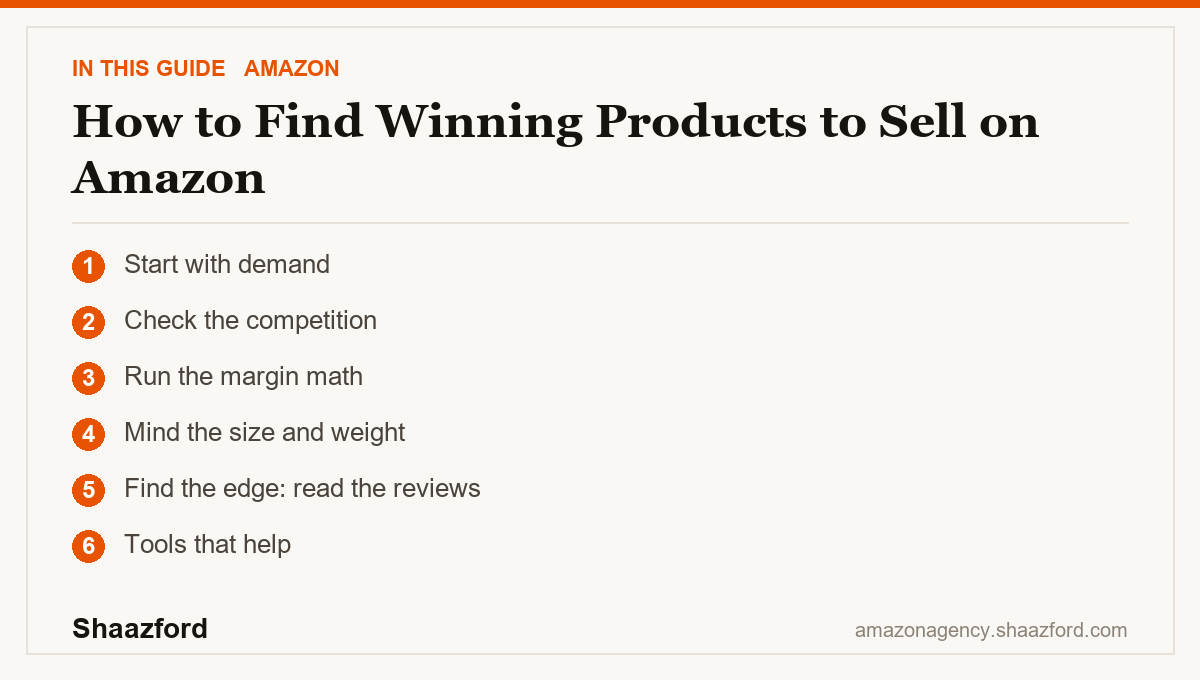
Start with demand
You are looking for evidence that people already buy this, not a hunch that they might. A common beginner benchmark is a niche where the leading products sell around 300 units a month or more, which works out to roughly 10 sales a day. Steady demand across several listings, not one lucky outlier, tells you the market is real. Amazon's Best Sellers pages and a research tool's sales estimates are the fastest way to see it.
Check the competition
Demand without room is a wall. Search your product idea and read two signals: how many results come back, and how many reviews the top listings carry. If a search returns several thousand results and every leader has hundreds or thousands of reviews, the niche is crowded and hard to break into as a beginner. Look instead for niches with a manageable result count and top sellers under about 400 reviews, which suggests you can compete on merit rather than years of accumulated social proof.
Run the margin math
A product only wins if there is money left after Amazon takes its share. Add up your landed cost (product plus inbound shipping), the referral fee (typically 15%), and the FBA fulfillment fee, then aim to keep at least 25% to 30% margin. A useful rule of thumb is a landed cost under about 30% of the retail price. In practice, a selling price around $30 to $70 tends to leave room, high enough to absorb fees, low enough that buyers do not overthink the purchase. Confirm every candidate in Amazon's Revenue Calculator before you order.
Mind the size and weight
Big and heavy quietly destroys margin. Storage fees are charged on the cubic feet your inventory occupies, and fulfillment fees scale with size and weight, so a bulky product can erase the margin you calculated. Favor items under about 5 pounds and compact dimensions. Small and light is easier to source, cheaper to ship, and more forgiving if you misjudge demand.
Find the edge: read the reviews
The four numbers get you a viable product. The pattern gets you a winning one. Open the top listings in your niche and read the 1 and 2-star reviews. The recurring complaints (a strap that breaks, a size that runs small, instructions no one can follow) are a map of what buyers wish existed. A product that fixes a real, repeated complaint has a reason to be chosen, which is worth more than a slightly cheaper copy of the market leader.
Tools that help
Amazon's own Product Opportunity Explorer analyzes searches, purchases, reviews, and pricing to surface gaps, and in 2026 it added two-year historical data and AI-driven demand insights, though it is limited to Professional sellers. Third-party suites like Jungle Scout and Helium 10 add sales estimates, keyword data, and competitor analysis. Use tools to speed up the four checks, not to replace the judgment of reading reviews yourself.
The beginner mistakes that cost the most
First, chasing a trend with no edge. A viral product with dozens of identical sellers is a race to the bottom on price. Trends fade, and without a real improvement you have nothing to defend.
Second, judging demand by one listing. A single bestseller can be an anomaly. Look for steady sales across several products before you trust the niche.
Third, forgetting fees until it is too late. A product that looks profitable on price alone often is not once the referral fee, FBA fee, and storage come out. Do the margin math first.
Fourth, ignoring size. Beginners fall for a product they love, then discover it is heavy or oversized and the fees make it unworkable. Screen for size early.
Where product research is heading in 2026
The biggest shift is that reviews now do double duty. Amazon's AI shopping assistant reads listings and customer reviews to answer buyer questions and shape recommendations, which means the complaints you mine for your edge are the same signals the AI surfaces to shoppers. A product with a pattern of unresolved negatives is exposed faster than ever, and a product that genuinely solves a common problem gets described favorably by the assistant. Research is no longer just about demand and margin. It is about picking something buyers will actually keep and praise.
Want help vetting products?
Finding one good product is doable. Building a repeatable process that vets demand, competition, margin, and fit before you spend is where most beginners stall. Shaazford runs Amazon product and growth strategy for brands, with senior Amazon agency directors and flat pricing, never a percentage of your ad spend. Follow along for more, and when you want a second set of eyes, talk to Shaazford.