
If you are trying to figure out how to sell on Amazon this year, the honest answer is that the mechanics are simple and the strategy has changed. You can open an account in an afternoon. Winning after that takes a clear process and an understanding of how Amazon works in 2026, where an AI shopping assistant now reads your listing on the customer's behalf. This is the no-fluff, step-by-step version.
To sell on Amazon, gather your documents, create a seller account and choose an Individual or Professional plan, research a product, optimize your listing, pick FBA or FBM fulfillment, then launch with ads and reviews.
Key takeaways
- Individual plan costs 99 cents per item; Professional costs $39.99 a month.
- Amazon charges an 8% to 15% referral fee, most categories at 15%.
- A new 3.5% fuel and logistics surcharge hit FBA fees in April 2026.
- Amazon's AI shopping assistant now reads listings and reviews, so write clear, honest copy.
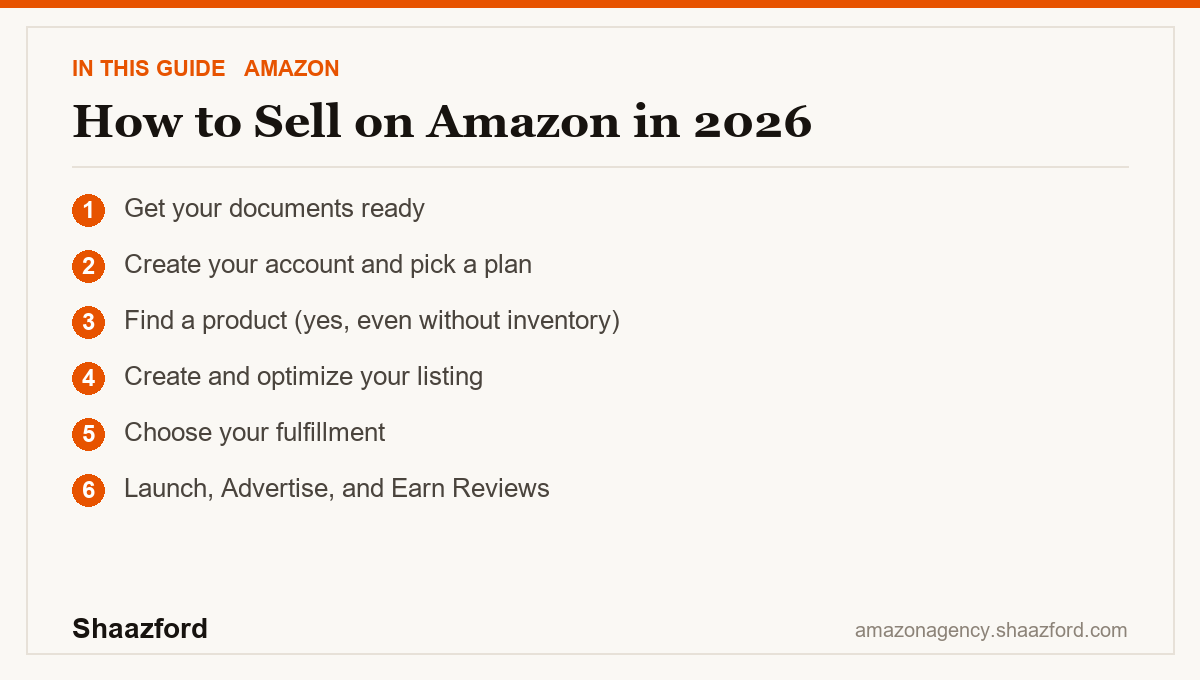
Step 1: Get your documents ready
Before you touch Seller Central, gather what Amazon asks for: a bank account (your payouts land there roughly every 14 days), a chargeable credit card, a government-issued photo ID, your tax information (an SSN for individuals or an EIN for a business), a phone number, and your legal business name and address. Most new accounts also complete an identity or video verification step, so have your ID ready.
Step 2: Create your account and pick a plan
Sign up at sell.amazon.com and choose one of two selling plans. The Individual plan costs 99 cents per item sold with no monthly fee, which suits you if you are selling fewer than about 40 items a month. The Professional plan costs $39.99 a month with no per-item fee and becomes the better deal once you pass roughly 40 units. You can switch plans anytime, so start where you are.
Step 3: Find a product (yes, even without inventory)
Do real product research before you spend a dollar. Validate demand against competition using a tool like Amazon's Product Opportunity Explorer. Beginners often ask how to sell on Amazon without inventory, the common routes are private label with a supplier, wholesale, or online arbitrage, and some sellers use third-party fulfillment so they never touch a box. Whatever the model, pick a product you can stand behind, because in 2026 a weak product is exposed faster than ever (more on that below).
Step 4: Create and optimize your listing
Your listing is your storefront. Write a clear title, benefit-led bullets, clean images, and, if you are brand-registered, A+ Content. Good SEO for Amazon listings still matters, but the definition has shifted. Amazon's shopping assistant now interprets your listing and your reviews to answer buyer questions, so keyword-stuffed titles read as noise. Structured, factual, honest copy is what both the algorithm and the AI reward.
Step 5: Choose your fulfillment
You have two options. FBA (Fulfilled by Amazon) means Amazon stores, picks, packs, and ships your orders and handles most customer service, in exchange for a per-unit fee. FBM (Fulfilled by Merchant) means you ship orders yourself and keep more control over margin and inventory. Many new sellers start FBM on low volume and move to FBA as they scale.
Step 6: Launch, Advertise, and Earn Reviews
Set a competitive price, then turn on Sponsored Products ads. If you are wondering how does Amazon PPC work, the short version is that you bid to appear on relevant searches and pay when someone clicks. Watch your ACoS (advertising cost of sale), but do not obsess over it in isolation, cutting bids to chase a lower ACoS often stalls your organic rank. Early reviews build trust; brand-registered sellers can use Amazon Vine to generate them compliantly. This is also most of the answer to how to rank on Amazon: relevant listings, converting ads, and genuine reviews compound into organic visibility.
What it costs to sell on Amazon in 2026
Beyond your plan fee, Amazon charges a referral fee on each sale, typically 8% to 15%, with most categories at 15% and a $0.30 minimum. If you use FBA, add a per-unit fulfillment fee based on size and weight. Two 2026 changes matter: FBA fulfillment fees rose by about 8 cents per unit in January, and Amazon added a new 3.5% fuel and logistics surcharge on FBA fees in April 2026. Referral fees themselves were held flat for the year. The takeaway: price with current numbers, and use Amazon's Revenue Calculator on your specific product before you commit.
The beginner mistakes that cost the most
Here is what quietly sinks new sellers. First, they treat optimization as keyword-stuffing. In 2026 that backfires, because Amazon's assistant is reading for meaning, not counting keywords. Second, they try to out-market a mediocre product. The AI now summarizes recurring complaints straight from your reviews, so a pattern of negatives can hurt your recommendations more than your rank ever could. Fix the product first. Third, they silo SEO and PPC, when Amazon actually uses ad conversion data to influence organic ranking. Treat them as one system.
Where Amazon is heading in 2026
The biggest shift is agentic AI shopping. In May 2026, Amazon folded its Rufus assistant into "Alexa for Shopping," a personalized assistant that lives in the search bar and on product pages, builds comparisons, and can help automate the purchase. Practically, that means your listing increasingly needs to be readable by an AI, not just a human skimming bullets. Clear specs, honest claims, and strong reviews are now a ranking and recommendation asset.
Ready to scale past the basics?
Getting started is the easy part. Scaling profitably on Amazon, PPC that protects margin, listings built for AI search, and a catalog that converts, is a full-time job. Shaazford runs Amazon growth for established brands under one strategy, with senior Amazon agency directors and flat pricing, never a percentage of your ad spend. If you are ready to grow, talk to Shaazford.