If you are searching for how to sell on Amazon without inventory, the honest answer is that you have several real options, and each one trades convenience for control in a different way. No inventory does not mean no cost and no rules, and one of these models has a compliance rule that suspends accounts when beginners ignore it. This is the straight version for 2026, the four methods that actually work, the fees that still apply, and the one rule you cannot skip.
Four real methods let you sell on Amazon without holding stock: print on demand, FBA, wholesale, and dropshipping. Fees still apply, and dropshipping requires you to be the seller of record.
Key takeaways
- Merch on Demand costs nothing to start; Amazon prints and ships per order.
- FBA means no handling, but you still own the inventory risk.
- Dropshipping requires being the seller of record; never fulfill via another retailer.
- Referral fees of 8 to 15% apply, plus FBA fees and the 3.5% surcharge.
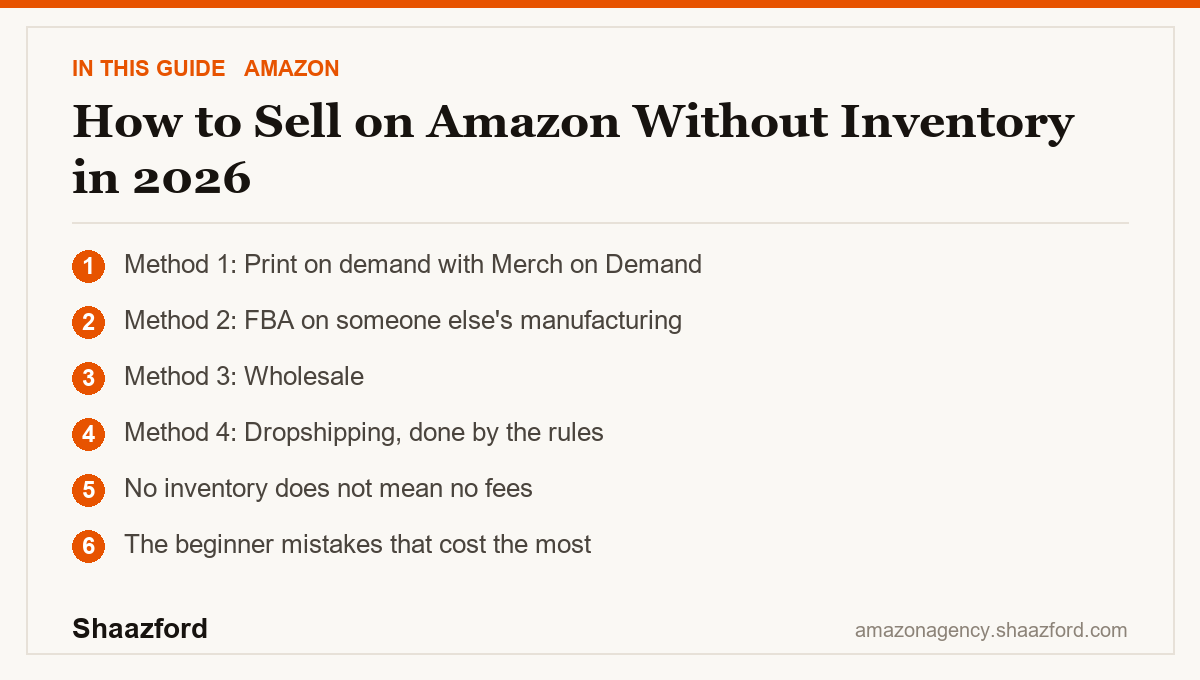
Method 1: Print on demand with Merch on Demand
Print on demand is the lowest-risk way to start. With Amazon Merch on Demand, you upload a design, set a list price on products like t-shirts, hoodies, mugs, and phone cases, and Amazon prints and ships each item only when a customer orders it. You never buy or store stock, and you earn a royalty on each sale. It costs nothing to start, which makes it the natural entry point for beginners and for anyone testing designs. The trade-off is margin. Royalties per item are modest, so print on demand rewards volume and strong design more than it rewards a single hero product.
Method 2: FBA on someone else's manufacturing
This one surprises beginners because it still counts as selling without touching a box yourself. With Fulfillment by Amazon, you buy products from a supplier or manufacturer, have them shipped into Amazon's warehouses, and Amazon handles storage, packing, delivery, and most customer service. You never personally warehouse or ship anything, yet your products are Prime-eligible and backed by Amazon's logistics network. You do own the buying decision and the inventory risk, so this is "no handling" rather than "no commitment." For most sellers who want to scale, FBA is the strongest long-term path.
Method 3: Wholesale
Wholesale means buying established, name-brand products in bulk from authorized suppliers or distributors and reselling them on Amazon. Compared with dropshipping or arbitrage, it offers more consistency because you are selling proven demand rather than betting on a new product. You can pair wholesale with FBA so you still avoid handling orders. The catch is that you buy in quantity and you need authorization to sell certain brands, so it asks for more capital and more supplier diligence than print on demand.
Method 4: Dropshipping, done by the rules
Dropshipping is the model people usually mean by "no inventory." A supplier ships each order directly to your customer, so you never hold stock. It is allowed on Amazon, but only under a strict policy, and this is the rule beginners miss. Amazon requires you to be the seller of record. Your name, not your supplier's, must appear on the packing slip, invoice, and packaging. You must remove any third-party branding, and you are responsible for returns and customer service. Critically, you cannot buy the item from another retailer such as Walmart and have them ship it to your customer. That specific practice is prohibited and is a fast route to account suspension. Dropshipping can work, but only if you control the fulfillment experience end to end.
No inventory does not mean no fees
Skipping stock does not skip Amazon's fees. You still pay a referral fee of roughly 8% to 15% depending on category on every sale. If you use FBA, add a per-unit fulfillment fee based on size and weight, plus the new 3.5% fuel and logistics surcharge Amazon added to FBA fees in April 2026. Print on demand bakes production cost into the royalty split, so your take-home per item is set for you. Whatever model you choose, run the numbers on your specific product before you list, because thin-margin models leave little room for a costing mistake.
The beginner mistakes that cost the most
The most expensive mistakes here are about compliance and math. First, treating dropshipping as "buy cheap somewhere, ship to the customer," which violates the seller-of-record rule and risks the account. Be the seller of record, or do not run the model. Second, ignoring fees because there is no inventory cost, then discovering the referral fee and FBA surcharge have erased the margin. Third, chasing the model with the lowest effort instead of the one that fits your goal. Print on demand is easy to start but hard to scale on thin royalties, while FBA asks for more capital but gives you Prime and reach. Match the model to what you are actually trying to build.
Where selling without inventory is heading in 2026
The direction of travel is toward more control, not less. Amazon continues to tighten enforcement on dropshipping that hides the true seller or relies on other retailers to fulfill, so the compliant, seller-of-record approach is the only durable one. At the same time, Amazon's AI shopping assistant now reads listings and reviews to answer buyer questions, which means low-effort listings with weak product experiences get exposed faster regardless of your fulfillment model. The lesson for 2026 is that "without inventory" changes how you fulfill, not whether you have to run a real, honest business behind the listing.
Want help choosing the right model?
Selling without inventory is a real path, but picking the right model and running it profitably is where most beginners stall. Shaazford runs Amazon growth for established brands under one strategy, with senior Amazon agency directors and flat pricing, never a percentage of your ad spend. If you want a second set of eyes on your approach, talk to Shaazford.