If you want to know how to launch a product on Amazon this year, the most useful thing to understand is that a launch is a sequence, not a single button you press on day one. The sellers who win do a set of things in a specific order, and the ones who struggle usually did the right things in the wrong order. This is the no-fluff Amazon product launch strategy for 2026, from the work you finish before launch day to the ads and promotions that build rank after it.
An Amazon launch is a sequence, not a single event. Finish the listing first, seed early reviews with Vine, run Sponsored Products for velocity, then add a coupon priced against current fees.
Key takeaways
- Finish the full listing before going live; traffic to a weak page is wasted.
- Seed early reviews compliantly with Amazon Vine, up to 30 per parent ASIN.
- Run Sponsored Products for velocity first in weeks one and two, efficiency later.
- Price against 2026 fees: 8 to 15% referral, FBA fee, 3.5% surcharge.
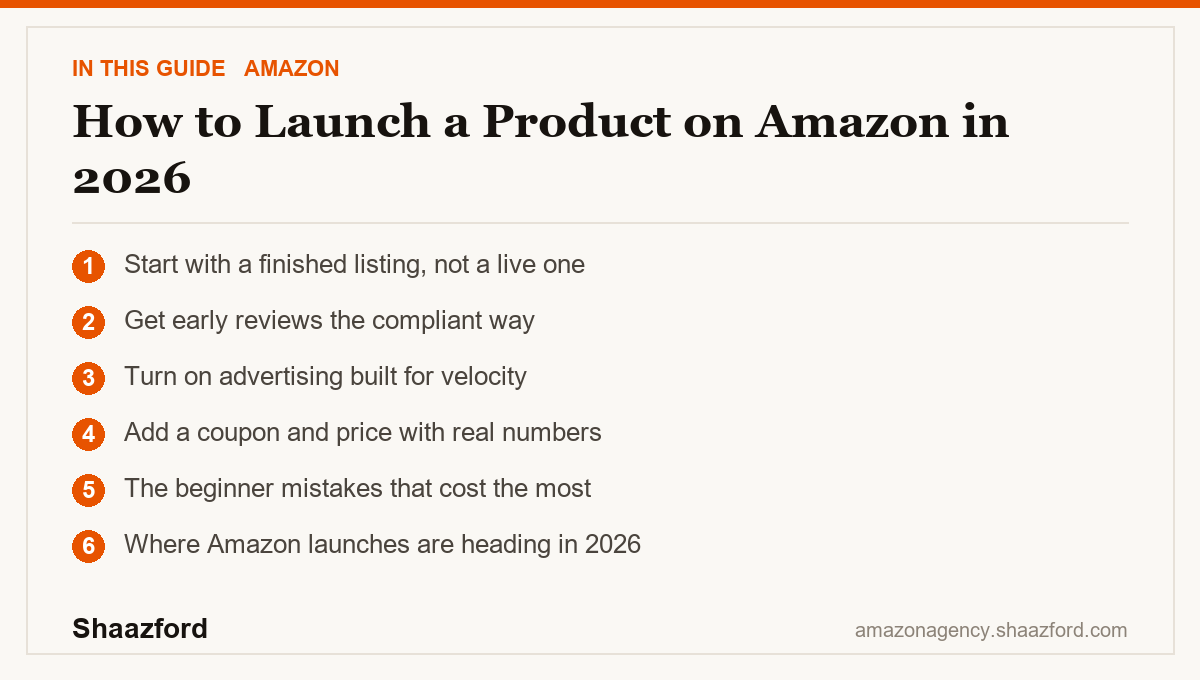
Start with a finished listing, not a live one
The biggest launch mistake happens before a single sale. Sellers make their product live with a half-built listing and then pay for clicks that never convert. Finish the listing completely first. That means a clear, benefit-led title, bullets that answer real buyer questions, clean and accurate images, and A+ Content if you are enrolled in Brand Registry. In 2026, Amazon's shopping assistant reads your listing and your reviews on the buyer's behalf, so structured, honest copy does more for you than a keyword-stuffed title ever will. Treat the listing as the foundation. Everything after it is traffic, and traffic to a weak page is wasted money.
Get early reviews the compliant way
A brand new listing with zero reviews converts poorly, and low conversion at launch is expensive because you are paying for the clicks. The compliant fix for brand-registered sellers is Amazon Vine, which sends your product to trusted reviewers in exchange for honest feedback. A single parent ASIN can receive up to 30 Vine reviews, and the enrollment fee is charged based on your product's list price, typically after the first review is published. A practical timing move is to enroll a couple of weeks before you scale your advertising, so social proof is already on the page when your paid traffic starts arriving. Never buy or incentivize reviews outside of Amazon's approved programs. It is the fastest way to lose an account.
Turn on advertising built for velocity
Once the listing is live and reviews are landing, start Sponsored Products. If you are new to Amazon PPC for launch, the important mindset shift is that the first two weeks are about buying velocity, not efficiency. Start with a focused campaign structure, bid to actually win placements on relevant keywords, and let the conversion data tell you which terms deserve more budget. In weeks three and four, scale the keywords that convert and trim the ones that only spend. You are teaching Amazon that your product sells when shown, which is the signal that drives organic rank.
Add a coupon and price with real numbers
A coupon gives your listing a green badge on the search results page, and that badge lifts click-through at exactly the moment you are trying to build momentum. Introductory pricing and time-limited discounts do similar work. Whatever promotion you choose, price it against current 2026 costs, not old ones. You still pay a referral fee of roughly 8% to 15% depending on category, an FBA fulfillment fee if Amazon ships for you, and the new 3.5% fuel and logistics surcharge Amazon added to FBA fees in April 2026. Run your specific product through Amazon's Revenue Calculator before you set a launch price, so your discount does not quietly erase your margin.
The beginner mistakes that cost the most
Three mistakes sink more launches than anything else. First, cutting bids in week one to protect a low advertising cost of sale. It feels responsible, but it starves the launch of the sales velocity Amazon uses to rank you. Feed the launch first and tune efficiency later, once you have rank to protect. Second, launching before the listing is finished, then blaming the ads when clicks do not convert. Fix the page, then buy traffic. Third, treating reviews as something to chase after launch instead of something to seed before it. A page that goes live with honest reviews and a complete listing converts from day one, and early conversion is what compounds.
Where Amazon launches are heading in 2026
Two shifts matter for new products this year. Agentic AI shopping is the big one. Amazon folded its Rufus assistant into a personalized shopping assistant that reads listings and reviews to answer buyer questions and build comparisons, so your launch copy increasingly has to be readable by an AI, not just a skimming human. The second shift is that Amazon has expanded programs and tooling aimed at helping new selection launch faster, which rewards sellers who prepare the full sequence in advance. The takeaway is the same either way. A launch that looks organized to the algorithm, with a clean listing, real reviews, converting ads, and honest claims, is what earns durable rank.
Ready to launch without the guesswork?
A clean launch sequence is simple to describe and hard to run while you also run the rest of a business. Shaazford launches and scales products on Amazon for established brands under one strategy, with senior Amazon agency directors and flat pricing, never a percentage of your ad spend. If you want a team that runs this sequence every week, talk to Shaazford.