
Every seller asking how to rank on Amazon wants a lever to pull. The honest answer in 2026 is that ranking is an output, not a lever. Amazon's search engine exists to show shoppers the listing most likely to satisfy their search and convert into a sale. Get that right and rank follows. Try to force it and it slips. This guide breaks down the two layers of Amazon SEO, relevance and performance, and where operators actually win.
Ranking on Amazon is an output, not a lever you pull. Relevance from your indexed listing text gets you into the running, and conversion rate then decides which listings move up.
Key takeaways
- Relevance from indexed listing text is the entry ticket to ranking.
- Conversion rate is the single most influential ranking signal.
- "A10" is an industry nickname, not an official Amazon term.
- External traffic that converts sends Amazon a strong quality signal.
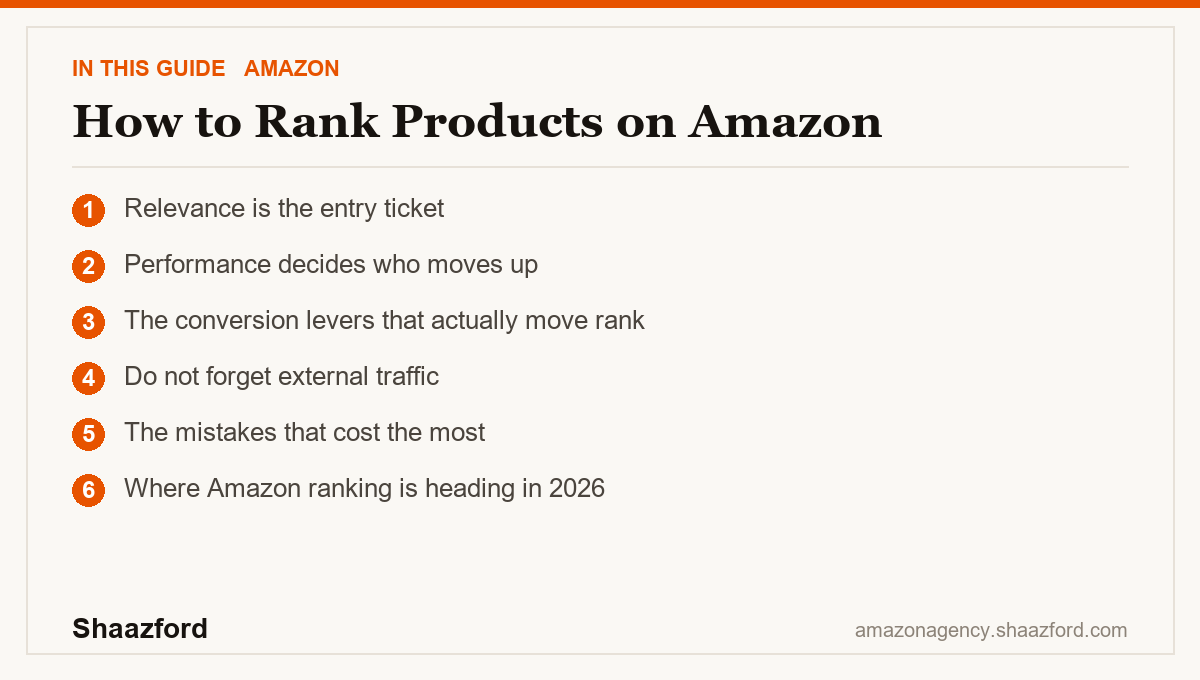
If the ASIN you are ranking is brand new, pair this with the 2026 Amazon product launch sequence, because launch-week signals set the ceiling for everything below.
Relevance is the entry ticket
Amazon can only rank you for a search if your listing is relevant to it. Relevance comes from the text Amazon indexes: your title, your Item Highlights, your five bullets, your backend search terms, and your A+ Content. If a buyer types a phrase that appears nowhere in those fields, you will not surface for it, no matter how good the product is.
So the foundation of Amazon SEO is still keyword research and placement. Pull the real phrases buyers use, prioritize by search volume and buyer intent, and place them where Amazon indexes them. Remember the 2026 constraints: from July 27, 2026, most titles are capped at 75 characters, backend search terms hold about 249 bytes with no repeats or commas, and only the first 1,000 bytes across your bullets are indexed. Relevance is necessary, but it is only the ticket into the auction. It does not decide who wins.
Performance decides who moves up
Once several listings are relevant to a search, Amazon ranks them by how well they perform. The signals that matter most are behavioral: click-through rate on the search page, conversion rate on the listing, and sales velocity over time. In plain terms, Amazon watches what shoppers do and promotes the listings that turn searches into sales.
Practitioners often call the current, behavior-weighted version of the algorithm "A10." That is an industry nickname, not an official Amazon name, so treat any precise "factor list" you see with healthy skepticism. What is well established is the direction: conversion rate is the single most influential signal, and the algorithm increasingly rewards engagement and trust over raw keyword matching.
The conversion levers that actually move rank
If conversion drives rank, then ranking work is mostly conversion work. The levers that matter:
- - Main image and title. These decide your click-through rate on the search page. A sharper main image often lifts rank more than any keyword edit.
- - Price and offer. A competitive price and a visible deal badge lift conversion directly.
- - Reviews and rating. Volume and recency of honest reviews are among the strongest trust signals. Brand-registered sellers can seed early reviews compliantly through Amazon Vine.
- - Fulfillment. A Prime badge and fast delivery raise conversion, which is part of why FBA listings often out-rank equivalent FBM ones.
- - Answered questions and clear copy. Resolved buyer questions reduce hesitation and lift conversion.
Fix these and rank compounds. Ignore them and no amount of keyword tinkering will hold a position.
Do not forget external traffic
One signal established brands underuse is off-Amazon demand. When a buyer arrives from your email list, your content, or a social post and converts, Amazon reads that as a strong quality signal, and you also capture the sale without paying for an internal ad click. Sending qualified external traffic to a listing that already converts is one of the cleaner ways to build durable rank. Sending it to a listing that does not convert wastes the traffic.
The mistakes that cost the most
First, and most expensive, is using ads to force rank on a listing that does not convert. Paid clicks that bounce teach Amazon your product underperforms for that search, so you pay to lower your own quality signal. Fix conversion first, then let ads accelerate a listing that already works.
Second is chasing keywords you cannot win. Ranking for a broad head term against entrenched competitors with thousands of reviews is a slow, expensive fight. Established sellers win faster by dominating specific, high-intent phrases first, then expanding.
Third is treating SEO and PPC as separate teams. Amazon uses ad conversion data as part of organic ranking, so they are one system. Your best-converting paid keywords are your best organic targets, and vice versa.
Fourth is neglecting the reviews and Q&A that carry trust. In 2026 Amazon's shopping assistant reads your reviews to answer buyer questions, so a pattern of unresolved complaints hurts both conversion and how the AI represents your product.
Where Amazon ranking is heading in 2026
The trend line is toward buyer behavior and trust, and away from keyword mechanics. Amazon's assistant, folded into "Alexa for Shopping" in May 2026, now reads listings and reviews to build comparisons and recommendations. That raises the bar in a useful way: the same things that make a listing genuinely good for a shopper, clear copy, honest claims, strong reviews, fast fulfillment, are exactly what earns rank and AI recommendation. There is less and less daylight between "optimized for the algorithm" and "actually the better product." Operators who internalize that stop hunting for tricks and start compounding the fundamentals.
Ready to rank on the fundamentals, not tricks?
Ranking on Amazon in 2026 is a conversion system: a relevant, indexed listing, a competitive offer, real reviews, tight fulfillment, and PPC and external traffic that reinforce each other. Running that as one machine, across a catalog, is what moves the needle. Shaazford manages Amazon growth for established brands under one strategy, with senior Amazon agency directors and flat pricing, never a percentage of your ad spend. If you are ready to compound rank the durable way, talk to Shaazford.