
If you are researching how to sell wholesale on Amazon, here is the honest framing: wholesale means buying genuine branded products from authorized distributors at a discount and reselling them on Amazon. You do not invent a brand or design a product. You resell things that already sell. The model is real and durable, but it lives or dies on two things: legitimate sourcing and clean account health. This is the step-by-step version.
Selling wholesale on Amazon means buying genuine branded products from authorized distributors at a discount and reselling them. It lives or dies on legitimate sourcing and clean account health, backed by valid distributor invoices for approval and ungating.
Key takeaways
- Wholesale resells existing branded products; you never create your own brand.
- Ungating usually needs a distributor invoice for at least 10 units, dated within 180 days.
- Fake invoices or retail receipts are a top cause of permanent suspension.
- Keep Order Defect Rate under 1 percent before applying for approval.
Selling wholesale to Amazon itself is a different model entirely, Vendor Central, where Amazon sends purchase orders and owns the retail price. If that is the route you are weighing, see what Vendor Central management involves before you commit.
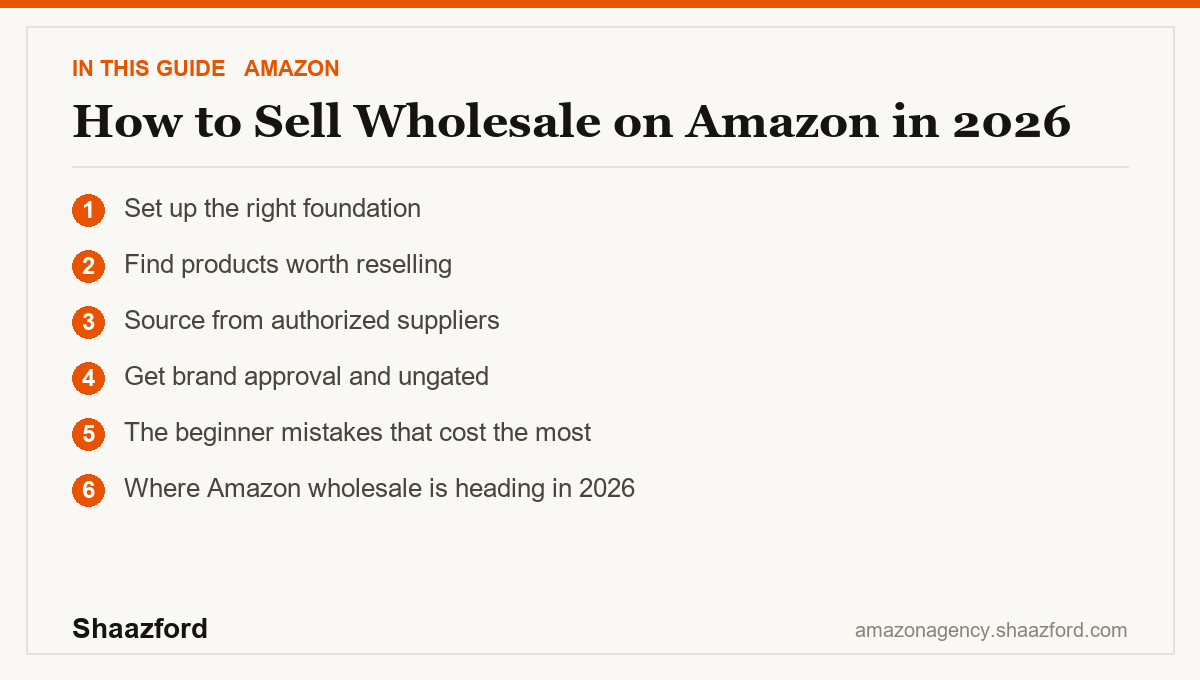
Step 1: Set up the right foundation
Start with a Professional seller account, which costs 39.99 dollars a month and makes sense for wholesale because you will move volume and need features the Individual plan lacks. Then get a resale certificate (also called a reseller's permit) from your state so you can buy inventory tax-free for resale. Most legitimate distributors will ask for this before they open an account with you. Have your business entity, tax information, and a business bank account ready, because you are setting up a real supply chain, not a side hobby.
Step 2: Find products worth reselling
Good wholesale products share a profile: an established brand with steady demand, a healthy margin after Amazon's fees, and a listing that is not already crowded with a dozen sellers racing to the bottom on price. Validate demand and competition before you commit, using a research tool to check sales velocity and how many sellers share the Buy Box. The goal is a product that sells consistently where you can win the Buy Box a fair share of the time, not the cheapest item you can find.
Step 3: Source from authorized suppliers
There are three legitimate ways to source in 2026, and all of them lead back to a real relationship:
- - Brand-direct outreach. Email the manufacturer, ask to open a wholesale account, and request their list of authorized distributors. Many mid-size brands will work with you if you can show clean Amazon metrics and a professional operation.
- - Vetted wholesale directories. Services like Worldwide Brands and Wholesale Central index legitimate suppliers. Directory inclusion is a starting point, not a guarantee, so still vet each supplier before ordering.
- - Trade shows. Events like ASD Market Week put you face-to-face with distributors who handle Amazon sellers routinely and treat invoice and approval requests as normal business.
Whatever the channel, the aim is an authorized distributor or the brand itself, with an invoice you can stand behind.
Step 4: Get brand approval and ungated
Two kinds of gates exist. A brand may require its own authorization to resell, which is where a brand authorization letter comes in. Separately, Amazon gates certain brands and categories and requires you to apply before you can list them. The standard approval path is the same: buy at least 10 units from an authorized distributor, obtain an invoice on the distributor's letterhead with their real contact details, and submit it with your application. Use a recent invoice, ideally within the last 180 days, since older documents raise the chance of rejection. Amazon typically reviews approval requests in about 2 to 7 business days, though a flagged case can take a few weeks.
Your account health has to be strong before you apply. Keep your Order Defect Rate under 1 percent, your late shipment rate under 4 percent, and valid tracking on the large majority of orders. Amazon weighs your performance when deciding whether to approve you.
The beginner mistakes that cost the most
Here is what quietly ends wholesale accounts. First, and by far the worst, buying fake invoices from a paid service or submitting a retail receipt instead of a distributor invoice. Amazon verifies supplier details against real distributor databases, and a forged or ineligible document is one of the top causes of permanent suspension. Recovery is rare. Second, sourcing from unauthorized middlemen who cannot prove authorization, which can trigger intellectual-property complaints from the brand. Third, letting account health slip right before an approval request, which gets you denied. Fourth, over-ordering a product before you have confirmed you can win the Buy Box and turn the inventory. Wholesale rewards patience and clean paperwork, not shortcuts.
Where Amazon wholesale is heading in 2026
Amazon keeps tightening the line between authorized and unauthorized resellers. More brands are gating their catalogs and enrolling in Brand Registry, which means more products require documented authorization to sell, and enforcement against forged documents has grown stricter. The practical effect is that clean supplier relationships are becoming a competitive moat: the sellers with genuine distributor accounts and authorization letters can access products that others simply cannot list. Building those relationships now, and protecting your account health, is what compounds in this model. The shortcut-driven version of wholesale is getting squeezed out, which is good news for operators who do it properly.
Want wholesale run by operators?
Wholesale is a legitimate, durable Amazon model, but sourcing, ungating, and account health are a full-time operation, and one bad invoice can undo it all. Shaazford runs wholesale and marketplace growth for established sellers, sourcing through approvals through account health, with senior Amazon agency directors and flat pricing, never a percentage of your ad spend. If you want it run properly, talk to Shaazford.